 English
  简体中文
简体中文 Recently, Assistant Professor Ye Bin of the School of Environmental Science and Engineering, Southern University of Science and Technology, published a study entitled “Two-tier Synergic Governance of GHG Emissions and Air Pollution in China’s Megacity, Shenzhen: Effect Evaluation and Policy Implication” in the leading journal Environmental Science & Technology.
The Long-range Energy Alternatives Planning (LEAP) model is widely used to simulate future energy production and consumption and the associated greenhouse-gas emissions. Based on a comparative analysis of greenhouse-gas (GHG) and air-pollutant inventory compilation guidelines and on localized emission factors, this study developed a customized LEAP model to track GHGs and major air pollutants (SO₂, NOₓ, VOCs, PM₂.₅ and PM₁₀) and to examine their co-reduction synergies under different policy scenarios. The model structure was tailored to the energy-emission characteristics of megacities. By coupling LEAP with the emission-factor method and using sector-specific activity data and emission factors for detailed energy types, Shenzhen’s GHG emissions were calculated bottom-up. The Weather Research and Forecasting (WRF) model was employed to simulate meteorological fields as meteorological input for the CMAQ simulation. Using 2015 as the base year, the developed WRF-SMOKE-CMAQ platform was validated. Simulated hourly mean PM₂.₅ concentrations in Shenzhen were compared with observed concentrations, as shown in Figure 1.
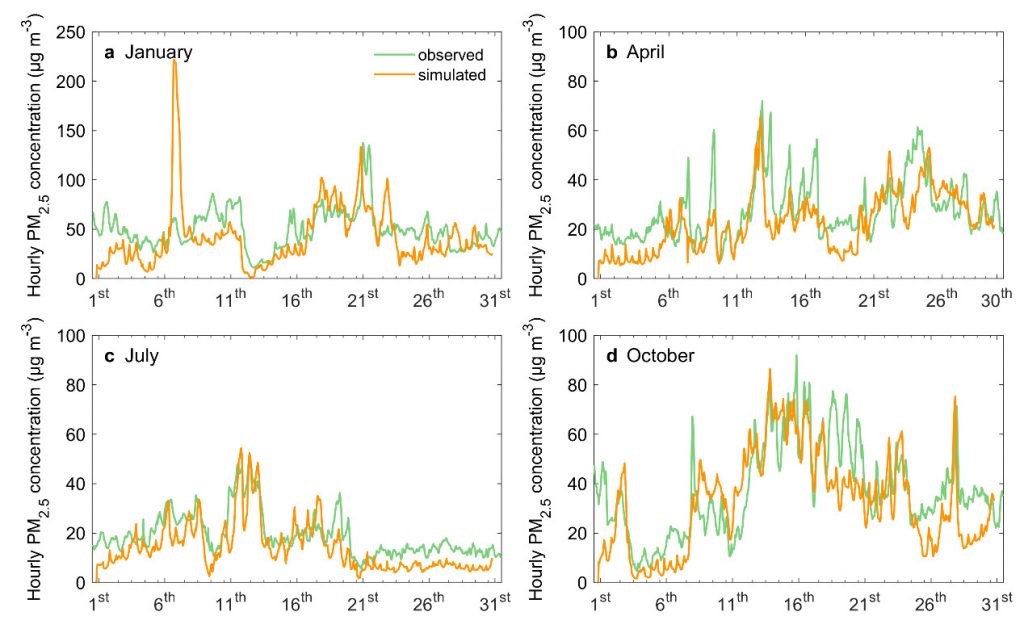
Figure 1 :Comparison of simulated and observed hourly mean PM2.5 concentrations for the baseline year 2015 in Shenzhen, panels a–d
An emission-inventory analysis was applied to quantify the contributions of imported electricity and local sources to urban GHG emissions. Meanwhile, model-based source apportionment of urban PM₂.₅ was performed, fully accounting for atmospheric dispersion, transport, deposition and chemical reactions. By coupling the GHG emission-inventory results with the PM₂.₅ source-apportionment results, imported electricity was found to account for 35.4 % of Shenzhen’s total GHG emissions, whereas inter-regional transport of air pollutants contributed 51.8 % to the city’s PM₂.₅ concentration (Figure 2).
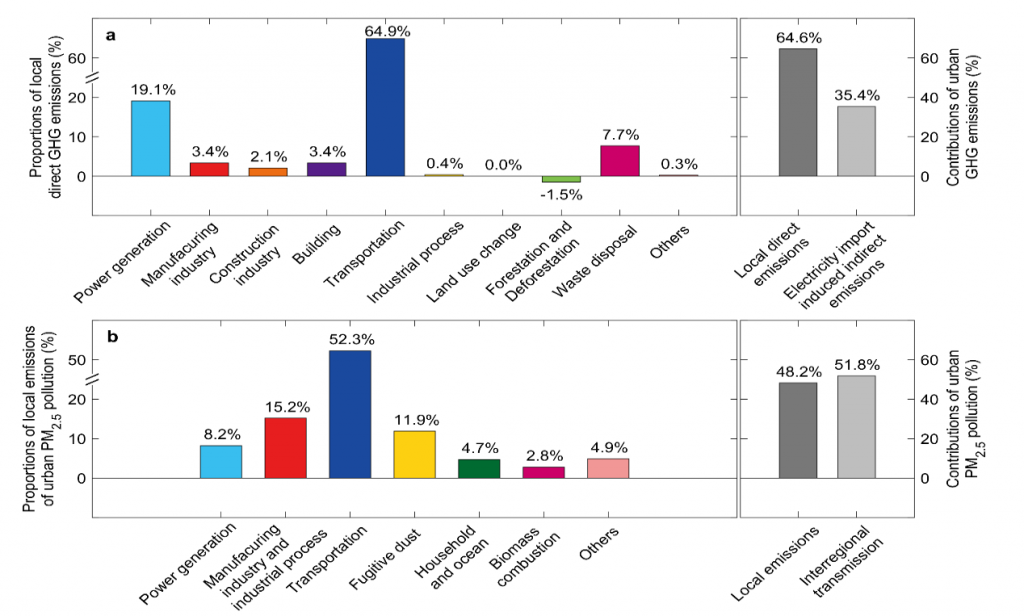
Figure 2 :Contributions of local and external sources to urban greenhouse-gas emissions and ambient PM2.5 pollution in Shenzhen in 2015
Figure 3 displays future GHG emissions in Shenzhen under four governance scenarios: reference (REF), active reduction (ACT), intensive reduction (INT) and regional synergic reduction (SYN). The SYN scenario introduces cooperation between Shenzhen and other cities in the Guangdong–Hong Kong–Macao Greater Bay Area to enhance GHG reductions in electricity supply, transport and other sectors.
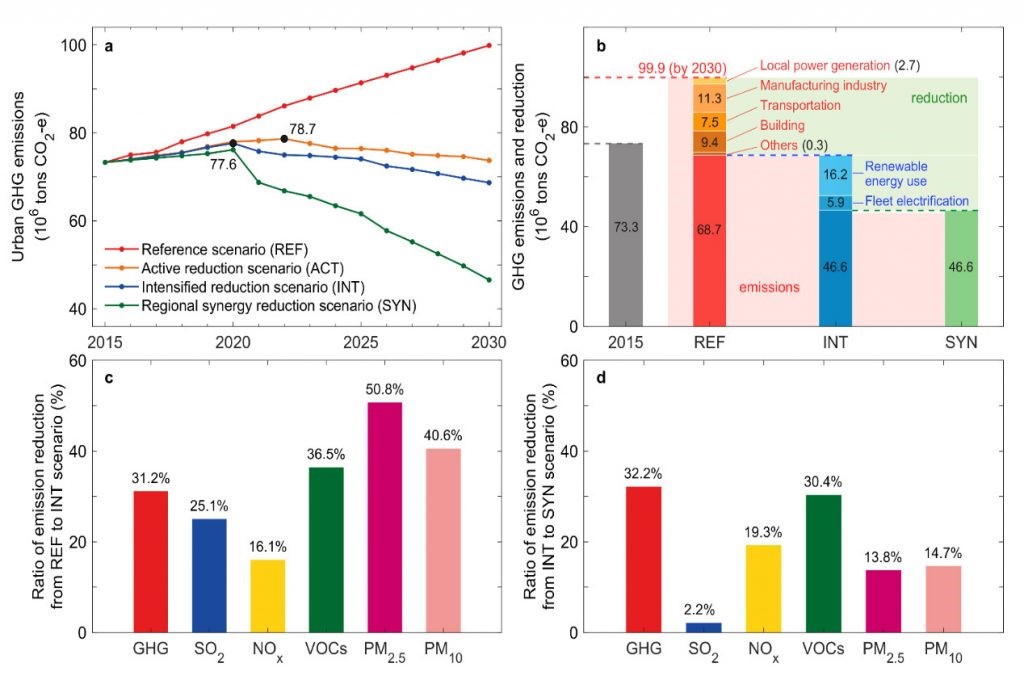
Figure 3: Future emissions and reductions of greenhouse gases and major air pollutants in Shenzhen under four different scenarios
Simulated annual mean PM₂.₅ concentrations in 2030 under three governance scenarios are shown in Figure 4. Under the single air-quality governance scenario, the 2030 annual mean PM₂.₅ concentrations at 11 monitoring stations in Shenzhen will decrease significantly compared with 2015, with reductions ranging from 20.8 % to 57.1 %. In 2030, except for Station 8 located in an industrial and densely populated area, the PM₂.₅ concentrations at all other stations will be below 25 μg m⁻³, achieving WHO interim target 2.
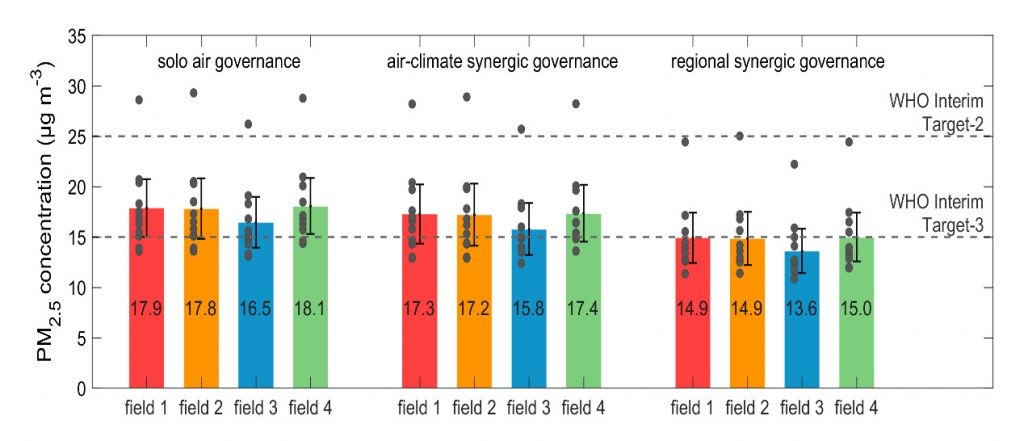
Figure 4 :Annual mean PM2.5 concentrations in Shenzhen in 2030 under three different governance scenarios
The study reveals the large potential of implementing a two-tier synergic governance strategy for GHG emissions and air pollution in Shenzhen. Road transport, power generation and manufacturing are the dominant sources of both GHG emissions and PM₂.₅ pollution in Shenzhen and should be prioritized. The Shenzhen case demonstrates the significant benefits of two-tier synergic governance, providing an important reference for other megacities facing the dual challenges of climate change and air pollution alongside increasing cost constraints. By leveraging synergies between GHG mitigation and air-pollutant reduction, as well as between urban and regional reductions, the proposed two-tier synergic governance offers important opportunities for large urban regions to formulate joint prevention and control schemes targeting multiple pollutants, thereby reducing overall emission-control costs and improving cross-boundary environmental governance efficiency.
Southern University of Science and Technology is the first corresponding affiliation. Assistant Professor Ye Bin is the corresponding author. Associate Professor Zeng Zhenzhong’s group and Professor Liu Junguo’s group from the School of Environmental Science and Engineering participated in parts of the research. The study was supported by the National Social Science Fund (20CGL036), the National Natural Science Foundation of China (71803074), the National Energy Foundation (G-1807-28052), Shenzhen Science and Technology Planning Projects (JCYJ20190806144415100 and JCYJ20190809162809440), and the National Key R&D Program (2018YFE0206200).
Article link: https://pubs.acs.org/doi/abs/10.1021/acs.est.0c06952