 English
  简体中文
简体中文 On August 18, the National Natural Science Foundation of China released the 2021 funding list. Assistant Professor Ye Bin’s proposal, “Comprehensive Benefit Evaluation and Incentive Mechanism of Grid-Scale Energy Storage under High Renewable-Energy Penetration,” was awarded a General Program grant from the Management Science Division. This represents another important achievement of the research group in the field of carbon peak and carbon neutrality. With project support, the group will conduct in-depth studies on pricing mechanisms for power-system flexibility resources to promote the development of energy-storage resources and the construction of a new-type power system. The research results are expected to provide a reference for power-grid companies and governments in formulating carbon-peak and carbon-neutral roadmaps.
Under the carbon-peak and carbon-neutral targets, the power sector’s primary pathway to deep decarbonization is large-scale deployment of renewable-energy generation represented by wind and solar power, together with a reduction in the share of thermal power. However, wind and solar generation are inherently intermittent and variable, so high renewable-energy penetration generally leads to insufficient flexibility resources. Flexibility resources provide buffering for renewable-energy integration and are a prerequisite for high renewable-energy penetration and deep power-system decarbonization. Yet, the absence of reasonable service pricing and investment-return mechanisms has resulted in a severe undersupply of flexibility resources in China’s power grid, constraining renewable-energy development and utilization.
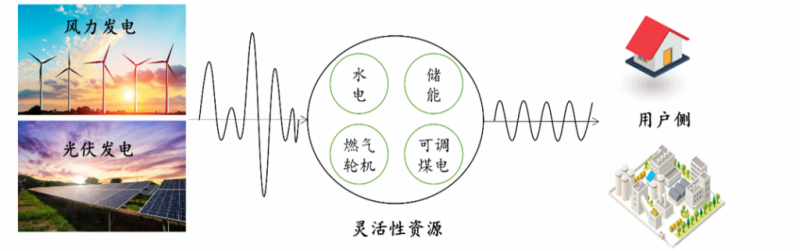
Taking grid-scale energy storage as a typical flexibility resource, this project will investigate benefit evaluation and incentive mechanisms for flexibility resources. First, a multi-dimensional benefit identification model for grid-scale energy-storage projects will be established to quantify the economic, environmental, and social benefits provided to the power system. Second, the gains and losses of various stakeholders involved in constructing grid-scale energy-storage facilities will be analyzed, a comprehensive evaluation model of energy-storage station construction will be built, and a mechanism design that achieves equilibrium among stakeholder interests will be sought. Finally, based on China’s current power-system structure, an incentive-compatible pricing mechanism for grid-scale energy-storage feed-in tariffs will be designed. Empirical evidence shows that a complete incentive mechanism can strongly promote renewable-energy development and utilization.