 English
  简体中文
简体中文 Recently, the research group led by Assistant Professor Ye Bin from the School of Environmental Science and Engineering at Southern University of Science and Technology published a paper titled “Review of natural origin, distribution, and long-term conservation of CO₂ in sedimentary basins of China” in the top-tier Earth science journal Earth-Science Reviews. This represents another significant research achievement by the group in the field of carbon peak and carbon neutrality, and is expected to provide a reference for large-scale CO₂ geological storage in China.
Due to the continuous rise in atmospheric CO₂ concentration and the resulting global warming, increasing attention has been paid to the CO₂ cycle. As part of the global carbon cycle, CO₂-rich gases exist in sedimentary basins worldwide, particularly in areas associated with deep faults or magmatic activity. Scholars around the world have conducted extensive research on CO₂ gas fields to verify the safety of long-term CO₂ storage in underground geological formations.
Globally, China’s sedimentary basins have the potential to store large amounts of CO₂. This paper analyzes different CO₂ fields in China to obtain detailed information on sedimentary basins. Based on this, the paper comprehensively reviews three key aspects of CO₂ reservoirs in Chinese sedimentary basins: the origin of CO₂, factors controlling CO₂ distribution, and the long-term effects of CO₂ emplacement on reservoir rocks.
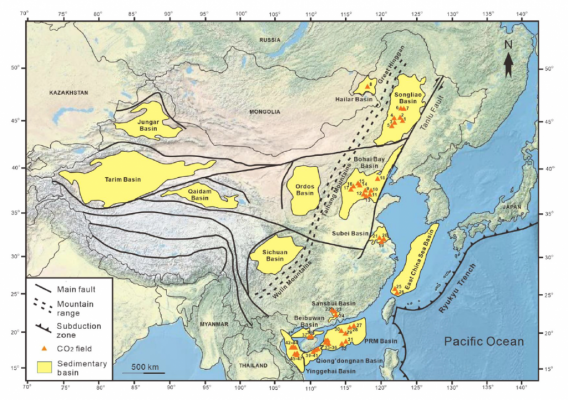
The sedimentary basins in eastern China are rift basins formed during the Cretaceous–Paleogene period. These basins, which include five onshore and five offshore basins, frequently contain CO₂-rich gases (>15%), and CO₂ gas fields have been discovered in these rift basins.
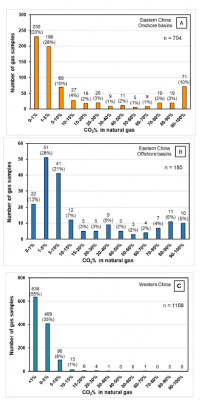
The sedimentary basins in western China are located in thicker crust and exhibit foreland basin characteristics influenced by the India–Asia orogeny. CO₂-rich gases (>15%) are rarely encountered in these intracontinental basins. In eastern China, the CO₂ content in natural gas shows a bimodal distribution: most reservoirs contain less than 10% CO₂, while reservoirs with CO₂ content exceeding 90% are also widespread. In contrast, CO₂ is also widely present in natural gas in western China, but generally at levels below 5%.
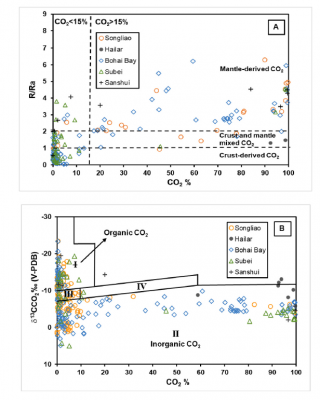
Carbon and helium isotopes indicate that CO₂ with high concentrations (>15%) in Chinese natural gas mainly originates from the mantle. Low-concentration CO₂ (15%) in the Yinggehai Basin.
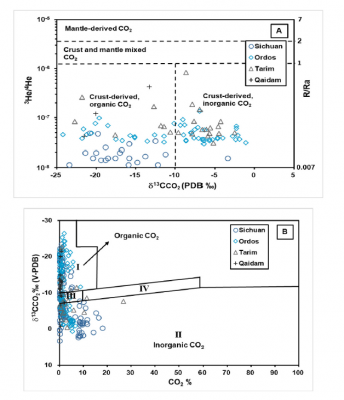
Low ³He/⁴He ratios indicate that intracontinental basins in western China are generally unaffected by mantle-derived gases. The low-concentration CO₂ in these basins is composed of organic and inorganic CO₂ from the crust. Some CO₂ gases in western China may be generated through TSR (thermochemical sulfate reduction). This type of CO₂ has been found in evaporite layers interbedded with carbonate rocks in the Tarim Basin and Sichuan Basin.
CO₂-rich gases in Chinese rift basins are typically found in shallow areas of the Moho discontinuity and regions with Cenozoic igneous activity. CO₂ may migrate from igneous sources to geological reservoirs through ancient volcanic vents or open faults, or igneous intrusions may directly inject CO₂ into reservoirs. CO₂ fields in China provide examples of CO₂ migration and accumulation in sedimentary basins.
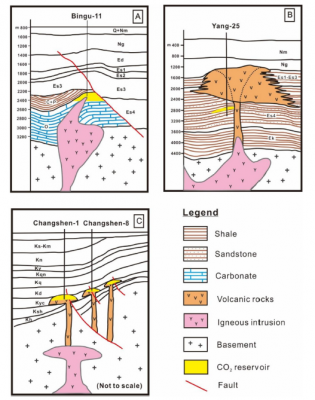
Faults are important pathways for CO₂ migration and distribution in Chinese rift basins. Long-distance horizontal migration of CO₂ may occur along basement faults, while small, common faults are often more important for local-scale CO₂ dispersion. In some rift basins, CO₂-rich gases are commonly found near the intersections of two faults. In the Yinggehai Basin, CO₂ fields are typically found in reservoirs within mud diapir structures at depths of 1,000–2,000 meters. Fluid data show that significant increases in CO₂ emissions are caused by elevated concentrations of HCO₃⁻ and Na⁺, possibly because China’s CO₂ reservoirs are mainly composed of feldspathic sandstone, followed by volcanic rocks. The dissolution of abundant aluminosilicates in volcanic rocks can greatly increase ion concentrations. Albite is the most common authigenic mineral observed in Chinese sandstone CO₂ reservoirs. Authigenic albite reduces reservoir porosity in a few CO₂ fields, but in most cases, CO₂ emplacement and albite growth do not appear to degrade reservoir quality. In carbonate reservoirs, CO₂ emplacement often increases porosity by dissolving carbonate minerals. The paper suggests that supercritical CO₂ can promote hydrocarbon accumulation by enhancing kerogen maturation and oil migration. However, some existing oil and gas may be displaced by later CO₂ emplacement, leading to the redistribution of hydrocarbons in shallow structures.