English
  简体中文
简体中文 Ye Bin’s research group has achieved new and important research results in the field of “dual carbon” studies. The latest issue of the renowned climate change journal Advances in Climate Change Research published the group’s paper titled “Potential and Roadmap of CO₂ Emission Reduction in Urban Buildings: Case Study of Shenzhen”.
The building sector accounts for approximately 40% of global energy consumption and carbon dioxide emissions. With the continuous advancement of urbanization, this proportion is expected to rise further. In cities—especially megacities—the building sector is increasingly becoming a major driver of energy consumption and CO₂ emissions. Effectively controlling carbon emissions from buildings is therefore crucial for cities to achieve their “carbon peak and carbon neutrality” goals.
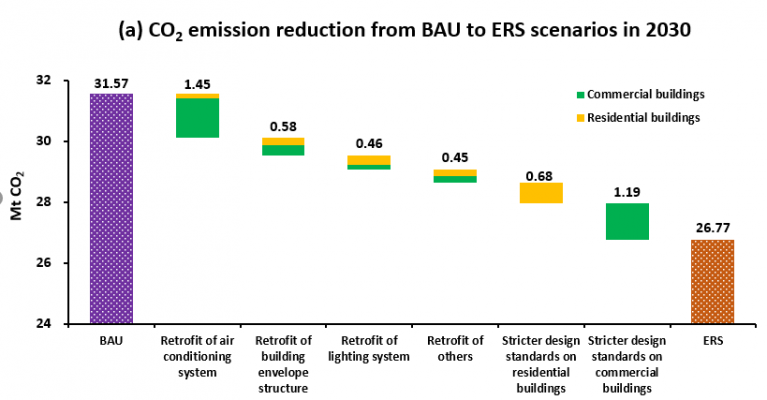
This study takes Shenzhen, a megacity in China, as a case study. Using the LEAP model, it systematically analyzes the impacts of emerging low-carbon technologies, emission reduction policies, and the changing role of prosumers on carbon emissions from urban building operations. It also explores the carbon peaking pathway for Shenzhen’s building sector and evaluates its cost-effectiveness. The study finds that carbon emissions from Shenzhen’s building sector could peak between 2022 and 2025, and could be reduced by over 60% by 2030 compared to the business-as-usual (BAU) scenario (Figure 1). Accelerating energy efficiency retrofits of existing buildings and implementing stricter design standards for new buildings (ERS scenario) can significantly reduce CO₂ emissions, but still cannot reverse the overall emission growth trend. Emphasizing collaborative efforts among stakeholders (ISE scenario) and strengthening building energy management and distributed renewable energy applications (REA scenario) will unlock additional emission reduction potential, enabling the building sector to reach its carbon peak and enter a rapid decline phase.
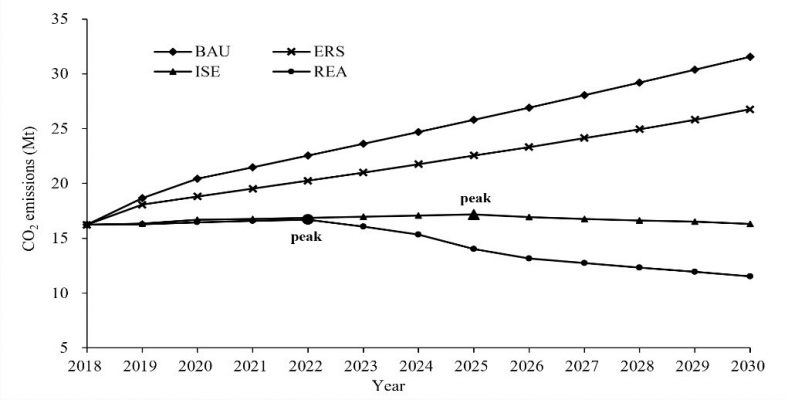
Figure 1. Carbon Emission Trends in Shenzhen’s Building Sector (Operational Stage) Under Different Scenarios
The study also analyzes the emission reduction potential and cost-effectiveness of 16 specific technological measures, including smart building energy management and distributed rooftop photovoltaics. Based on this analysis, a carbon peaking technology roadmap for Shenzhen’s building sector is proposed (Figure 2). The findings are expected to serve as a reference for emission reduction in other cities, including: (1) Most technological measures can significantly reduce energy bills during the building operation phase, thereby offsetting their initial investment and operational maintenance costs; (2) Energy efficiency upgrades for lighting, air conditioning, external shading, plumbing, elevators, and other systems in existing buildings, along with the promotion of energy-efficient transformers, occupant behavior education, and smart building energy management, can achieve both energy savings and economic benefits, and are recommended for priority implementation; (3) Implementing stricter design standards for new buildings may not yield short-term economic benefits, but helps avoid high-carbon lock-in effects and is also recommended for early implementation; (4) At present, the promotion and application of distributed renewable energy in buildings is costly but has significant emission reduction potential. It is recommended to be gradually advanced in line with the transformation of China’s electricity market and the development of smart grids.
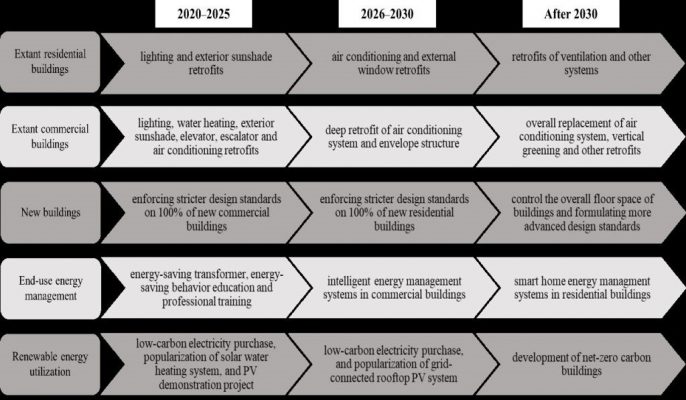
Figure 2. Technology Roadmap for Carbon Peak in Shenzhen’s Building Sector
Dr. Jing Jing from Harbin Institute of Technology (Shenzhen) is the first author of the paper. Dr. Ye Bin is the corresponding author. The School of Environment at Southern University of Science and Technology is the sole corresponding affiliation.