 English
  简体中文
简体中文 On December 30, 2022, the project “Research on the Synergistic Mechanisms between the Power Market and the Carbon Market”—led by Assistant Professor Bin Ye from the School of Environmental Science and Engineering, Southern University of Science and Technology—successfully passed the final acceptance review in Wuhan, Hubei, under the commission of the State Grid Corporation of China. With the steady advancement of China’s “dual-carbon” strategy, the traditional power system is undergoing a profound transformation toward a new-type power system. Deepening the reform of the energy system has become an inevitable requirement for the sustainable socioeconomic development under the carbon peaking and carbon neutrality goals. This project addresses the current challenges of China’s electricity market and carbon market operating independently, with limited synergy and integration. Focusing on policy objectives, core elements, operational status, and key mechanisms of both markets, the study systematically analyzed the inherent coupling relationships between them. It further examined critical issues in market coordination, including the lack of effective incentive mechanisms, weak policy coherence, and inconsistencies in accounting methodologies. On this basis, the project proposed key mechanisms to enhance power–carbon market coordination and developed an overall framework for their integration.
The research reviewed carbon emission accounting methodologies and standard systems from typical international carbon markets, quota setting approaches, allocation methods and instruments, as well as the price transmission and linkage mechanisms between power and carbon markets. These insights provide a valuable reference for designing China’s power–carbon market integration scheme. The study also assessed the operational status and key constraints of China’s pilot carbon markets, the national carbon market, the green electricity market, and the green certificate market. Drawing on the practical experience of Hubei Province’s power–carbon coordination pilot, the project explored possible product types and market forms under the integrated power–carbon framework, and further designed innovative medium- and long-term pricing strategies alongside a Low-Carbon Transition Index. A comprehensive decision-making model for market transactions under the power–carbon integration context was also developed, focusing on key stages such as quota allocation, trading, and compliance, thereby proposing an overall system design.
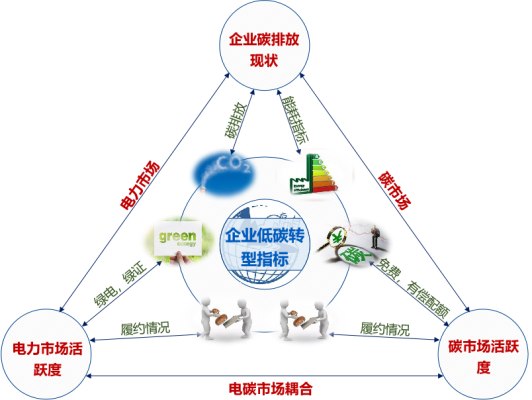
Framework for Measuring the Low-Carbon Transition Index
The project ultimately aims to establish and refine a coupled power–carbon market that accommodates the participation of renewable energy. It seeks to advance the clean and low-carbon transformation of China’s energy system while safeguarding national energy security, thereby providing robust theoretical foundations and policy support for China’s sustainable development agenda.