 English
  简体中文
简体中文 In early June, the research group of Assistant Professor Bin Ye from the School of Environmental Science and Engineering, Southern University of Science and Technology, published a paper entitled “Low-carbon energy policies benefit climate change mitigation and air pollutant reduction in megacities: An empirical examination of Shenzhen, China” in the international journal Science of The Total Environment. Using Shenzhen as a case study, the research systematically examined the co-benefits of low-carbon policies in reducing greenhouse gas (GHG) emissions and controlling urban air pollution, and further proposed integrated urban management strategies that optimize energy systems while enhancing synergies with air pollution control.
The study first provided a systematic review of recent research progress in the field, highlighting both the importance of urban carbon reduction and the necessity of systematic approaches to air pollution control. Current evidence shows that different cities must design their GHG mitigation policies in line with local conditions, considering factors such as energy structure, geography, and industrial composition. Improving energy efficiency remains a powerful approach to reduce urban GHG emissions, while optimizing the energy mix by integrating renewable energy will play a critical role in the future. Complementary measures—including low-carbon buildings, carbon trading mechanisms, and low-carbon education—also contribute to urban GHG reduction. In terms of air pollution, many studies have focused on PM2.5, pointing out severe air quality challenges under conventional energy systems. However, existing pollution control technologies are mostly end-of-pipe solutions and lack comprehensive coverage. Importantly, there has been limited research on the co-effects of environmental policies on both GHG mitigation and air pollution control in megacities. Against this backdrop, this study selected Shenzhen as a case study, conducting a systematic analysis of the synergies between energy system optimization, GHG mitigation, and air pollution control for the first time at the city scale.
Methodologically, the research innovatively improved the traditional LEAP (Long-range Energy Alternatives Planning) model by integrating air pollutants into its framework to simulate multiple policy scenarios at the city level. A clear definition of boundaries, coverage, and categories of both GHGs and air pollutants was established. GHGs included carbon dioxide, methane, and nitrous oxide (while excluding HFCs, PFCs, and SF₆ due to low emissions and data limitations). Air pollutants covered within city boundaries included PM2.5, SO₂, NOx, and VOCs. A refined industry classification method was developed to better capture the co-effects of GHG and air pollutant emissions, encompassing three major categories—stationary combustion, mobile combustion, and waste treatment—with 15 subcategories. This enhanced LEAP framework enabled targeted simulation of the co-benefits between GHG reduction and air pollution control.
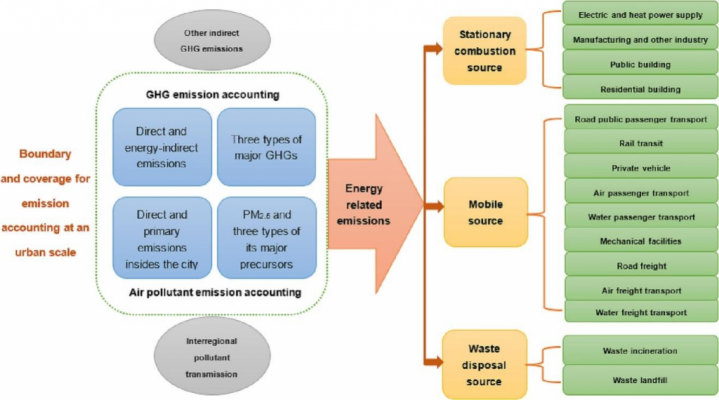
Figure 1. Examples of boundaries, scopes, and industry classifications of greenhouse gas emissions and air pollutants at the city scale
Shenzhen was then introduced as a case study, with details on its geographic location, political role, economic scale, and carbon emissions trajectory. Between 2005 and 2015, Shenzhen’s GHG emissions grew rapidly, but the growth slowed after 2015. Meanwhile, since 2011, Shenzhen has achieved significant reductions in PM2.5 concentrations. As both a pilot demonstration zone for socialism with Chinese characteristics and a national low-carbon city pilot, Shenzhen serves as an ideal case for evaluating low-carbon policy impacts. The LEAP model was used to simulate the co-effects of policies on GHG and air pollutant emissions from 2021 to 2035 under three scenarios: (1) Reference Policy Scenario, assuming continuation of existing or planned policies; (2) Active Policy Scenario, simulating proactive improvements in energy structure and climate policies; and (3) Aggressive Policy Scenario, simulating radical measures toward decarbonization through large-scale deployment of renewable energy and transportation reforms. These scenarios were compared across key sectors including power generation, industry, transport, and buildings.
Results showed that under the Reference Policy Scenario, both GHG and air pollutant emissions will continue to grow, posing complex environmental challenges for Shenzhen. Under the Active Policy Scenario, GHG emissions are projected to rise slightly in the short term before gradually declining. Air pollutant emissions follow a similar pattern: most pollutants peak around 2026 before steadily decreasing, while NOₓ shows a temporary surge before declining after 2027. The Aggressive Policy Scenario demonstrates more significant reductions, synergistically curbing both GHGs and air pollutants more effectively than the Active Policy Scenario.
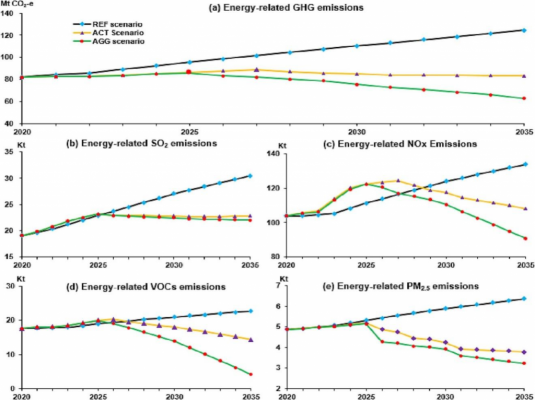
Figure 2. Simulation of Energy Related Greenhouse Gas and Air Pollutant Emissions under Three Policy Scenarios
The simulations highlight the substantial mitigation potential still available in Shenzhen and demonstrate that reducing GHG emissions can also bring considerable air quality co-benefits. Sectoral differences in co-effects were evident: for instance, the building sector showed limited synergy due to low direct emissions, while strong co-benefits were observed in the power and transport sectors.
In addition, policy analysis further showed that measures such as large-scale deployment of distributed photovoltaics, shifting freight from highways to waterways, and promoting solar-powered trucks have significant co-benefits for both GHG and air pollutant reduction.
The study reveals Shenzhen’s substantial potential as a global megacity for achieving synergistic reductions in GHG emissions and air pollution under proactive and well-designed environmental policies, and reveals the impact of different environmental policies on emission reduction in different industries.
This research was supported by the National Social Science Foundation of China (20CGL036), the National Natural Science Foundation of China (72173058), and the Shenzhen Natural Science Foundation (JCYJ20190806144415100, JCYJ20190809162809440).