 English
  简体中文
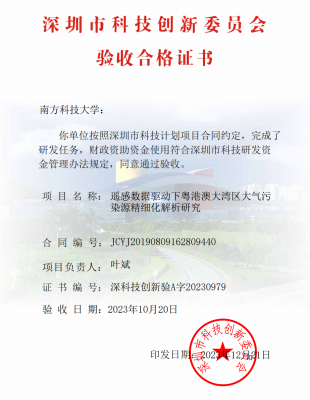
简体中文 On December 21, 2023, the Shenzhen Science and Technology Program Project “Fine-Scale Source Apportionment of Air Pollution in the Guangdong–Hong Kong–Macao Greater Bay Area Driven by Remote Sensing Data”, led by Assistant Professor Bin Ye of the School of Environmental Science and Engineering, Southern University of Science and Technology, successfully passed the final review and acceptance organized by the Shenzhen Science and Technology Innovation Commission, and was awarded the project completion certificate.
The Guangdong–Hong Kong–Macao Greater Bay Area (GBA) is one of China’s most important economic regions, as well as a key area for air pollution prevention and control. Air quality data released by the Guangdong Provincial Department of Ecology and Environment show that the region continues to face severe air pollution challenges. To address the issues of urban air pollution source identification and control in the GBA, and to support the formulation of effective pollution prevention policies and targeted environmental enforcement, the project investigated the diffusion and transport mechanisms of air pollutants, developed a fine-scale source apportionment and evaluation framework, and carried out empirical studies. The results provide a scientific basis for designing precise, city-specific as well as regionally coordinated pollution control strategies.
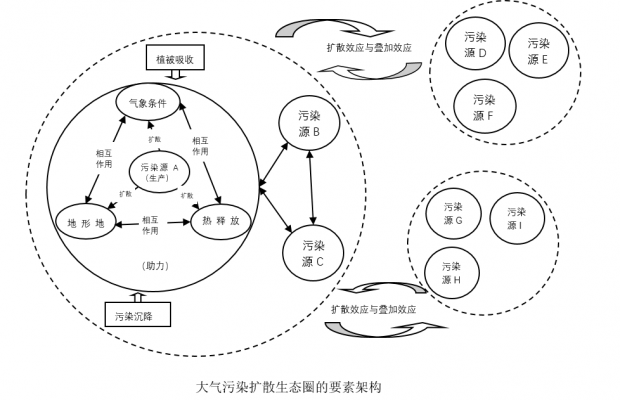
By analyzing the dispersion mechanisms and influencing factors of air pollution in urban agglomerations, the project developed an ecological framework for air pollution diffusion, laying a theoretical foundation for fine-scale source apportionment techniques. Leveraging remote sensing data and analytical methods, the team established methodologies and evaluation standards for source identification, enabling the recognition of major pollution sources and quantification of their contributions. Based on the status, causes, dispersion patterns, and trends of regional air pollution, the study further proposed innovative prevention and control strategies tailored for the GBA. This research not only supports government and enterprises in accurately identifying pollution sources with high-efficiency data, but also provides analytical tools for formulating precise, city-specific, and regionally coordinated air pollution control policies.
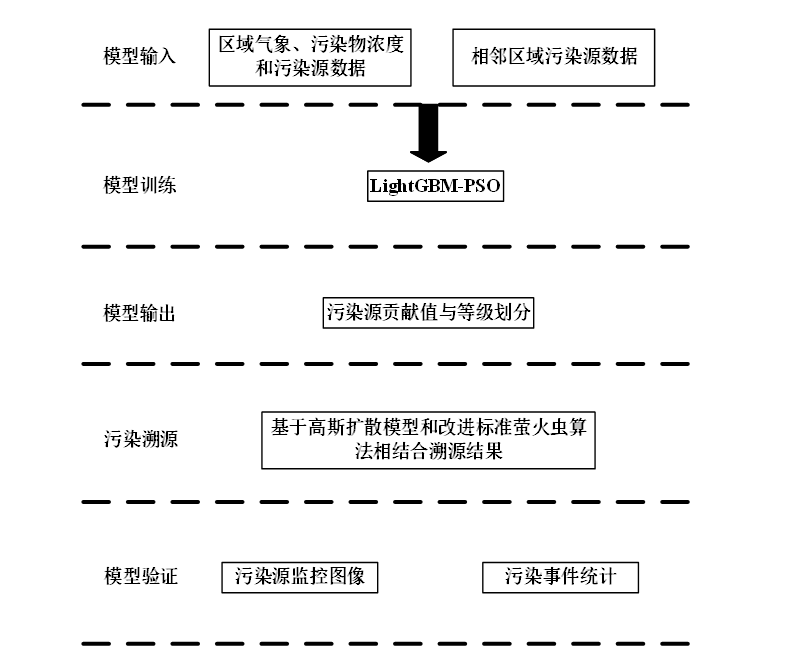
A title
Framework of Accurate Traceability System for Air Pollution
Throughout the research process, the project team followed rigorous scientific methods and workflows to ensure the accuracy and reliability of results. Centered on the urgent demand for joint prevention and control of air pollution in the GBA, the team conducted multiple field investigations, collected extensive datasets, performed systematic analyses and model construction, and established a comprehensive and scientific research framework. The project yielded several innovative outcomes, including the publication of 7 high-quality academic papers (4 indexed in SCI and 3 in EI), the training of two master’s students, and the successful achievement of all academic objectives.
The successful implementation of this project marks an initial realization of fine-scale source apportionment methods and evaluation standards based on remote sensing imagery, and demonstrates their practical effectiveness. It also highlights the accumulation and maturity of Bin Ye’s group in the field of regional air pollution joint prevention and control. Moving forward, the group will continue to focus on fundamental scientific questions in atmospheric environment research, contributing to China’s ecological civilization development and pollution prevention efforts.