 English
  简体中文
简体中文 Recently, the research group led by Ye Bin from the School of Environmental Science and Engineering at Southern University of Science and Technology (SUSTech) published a research paper titled "Does green finance ensure energy security while achieving low-carbon transformation of listed electricity firms? Evidence from China" in Energy Economics, a top international journal in the field of energy economics. The study constructed a regional Low-Carbon Energy Security Index (LCESI) and employed a Difference-in-Differences (DID) model to systematically evaluate, for the first time, the synergistic effects of green finance policies between macro-level regional energy security and micro-level corporate low-carbon transition. This provides empirical evidence from China for mitigating conflicts within the "energy trilemma."
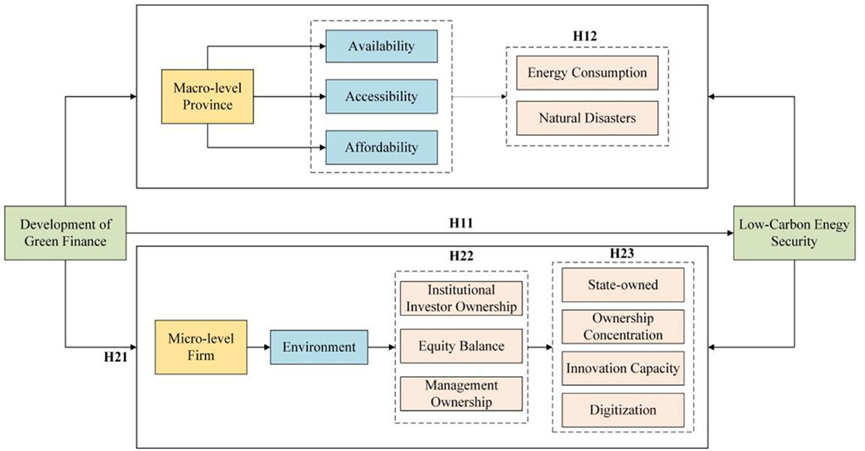
Figure 1 Theoretical framework of green finance's impact on low-carbon energy security (LCESI)
The power industry is a critical battleground for achieving the United Nations Sustainable Development Goals and China's "dual carbon" goals. However, the power system faces a dual challenge: it must reduce emissions through an aggressive decarbonization transition while ensuring the security and stability of energy supply amidst increasing volatility from renewable sources. Green finance, as a key policy tool for promoting sustainable development, has gained wide recognition for its role in reducing carbon emissions. Yet, whether it can simultaneously ensure energy security while fostering a low-carbon transition lacks systematic quantitative assessment in academia.
Addressing this issue, the research team innovatively constructed a Low-Carbon Energy Security Index (LCESI) based on four dimensions: availability, accessibility, affordability, and environmental sustainability. They also proposed an integrated analytical framework connecting macro-regional and micro-enterprise levels (Figure 1). This framework elucidates how green finance, through capital support and policy incentives, influences corporate governance and decision-making mechanisms at the micro level, thereby affecting the structural characteristics of regional energy systems and low-carbon energy security performance at the macro level.
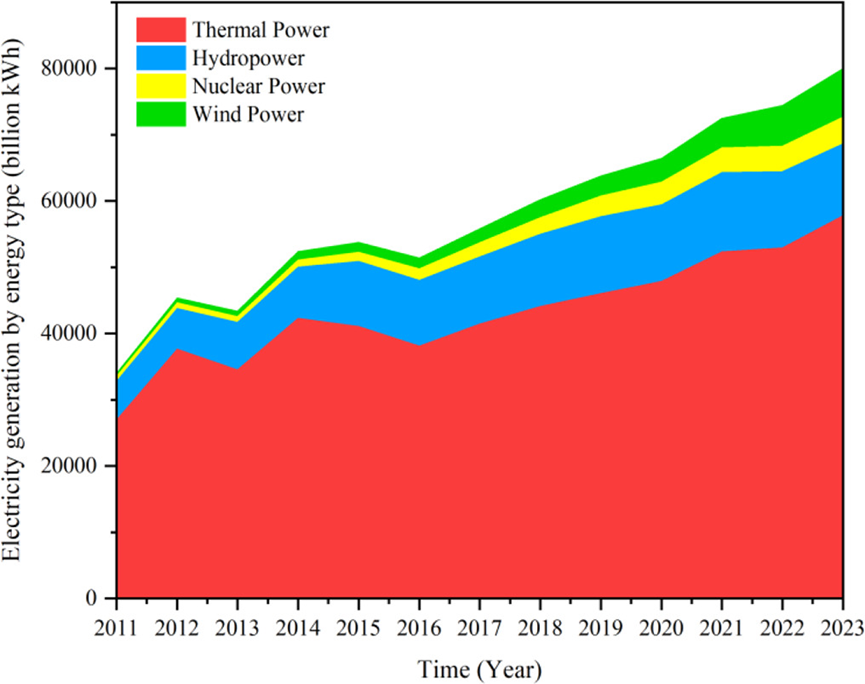
Figure 2 Changes in China's power generation structure by energy type (2011-2023)
As the world's largest power system, China's electricity sector is in a critical phase of low-carbon transition, providing a unique real-world scenario for assessing policy effectiveness. The research team compiled industry data from 2011 to 2023 (Figure 2). The results show that while thermal power remains dominant, electricity generation from renewable sources such as wind and solar has exhibited significant growth. Accompanying the adjustment of the energy structure, preliminary evidence indicates a close correlation between the development of green finance and the decline in regional pollutant emissions like sulfur dioxide (Figure 3), reflecting the positive environmental effects already achieved by the low-carbon transition. However, the rapid increase in the share of renewables also imposes new constraints on the stable operation and supply security of the power system, making the trade-off between decarbonization goals and energy security more pronounced. It is precisely within this real-world context that the question of how to assess whether green finance can balance energy security while promoting the low-carbon transition formed the core starting point for the empirical analysis in this study.
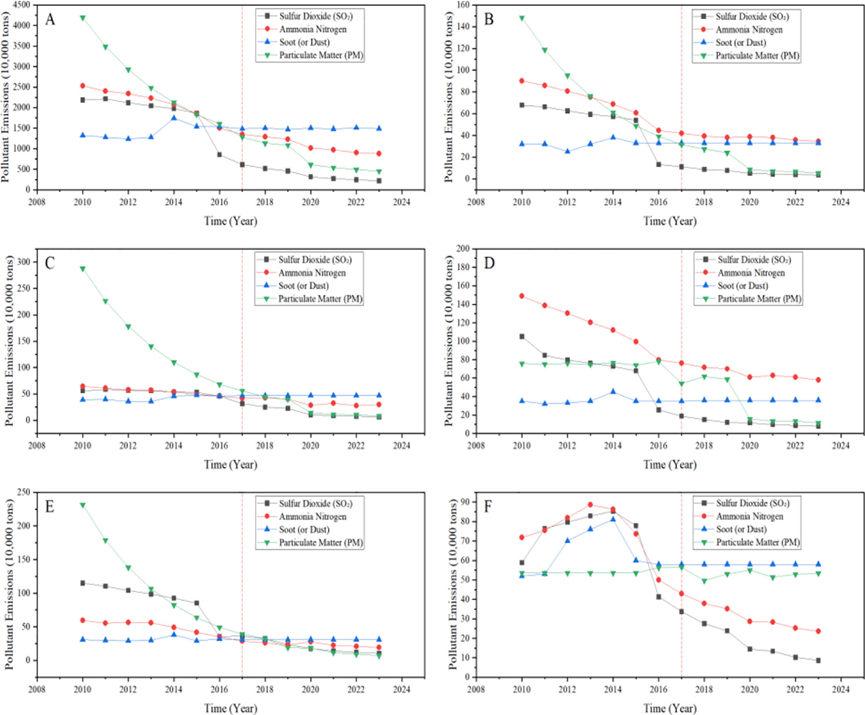
Figure 3 Trend changes in pollutant emissions in green finance pilot regions (2010-2023)
To accurately identify the policy effects, the research team utilized provincial and corporate panel data, treating the national Green Finance Reform and Innovation Pilot Zones as a "quasi-natural experiment," and employed a Difference-in-Differences (DID) model for empirical analysis. The study found that China's overall regional Low-Carbon Energy Security Index (LCESI) showed a fluctuating upward trend over the past decade, with growth becoming more robust especially after the implementation of the green finance pilot policy in 2017 (Figure 4). Further analysis at the macro level revealed that although the average effect of the green finance policy across the country is heterogeneous, its marginal effect on enhancing energy security is significantly stronger in high energy-consuming regions and areas frequently affected by natural disasters. This suggests that in regions facing high energy demand pressure or high climate vulnerability, green finance has, to some extent, enhanced the stability and resilience of the energy system by supporting investments in resilient infrastructure.
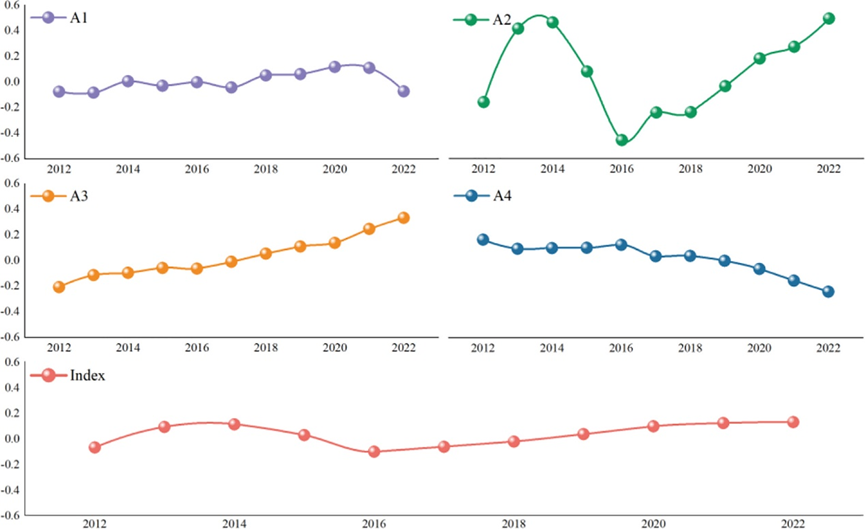
Figure 4 Evolution Trends of the Regional Low-Carbon Energy Security Index (LCESI) and Its Sub-Indicators (2012-2022)
At the micro-enterprise level, the research further confirms the emission-reduction effect of green finance. The empirical results indicate that the green finance policy significantly reduces the carbon emissions of listed power companies. Mechanism analysis reveals that institutional investor shareholding, checks and balances in shareholding, and managerial shareholding play crucial moderating roles in the policy transmission process. State-owned enterprises, firms with high ownership concentration, and companies with strong innovation capabilities and digitalization levels demonstrate a greater capacity for green transformation when supported by the policy.
This study not only enriches the theoretical framework in the field of energy economics but also provides crucial insights for policymakers: When advancing the low-carbon transition of the power industry, green finance strategies should be implemented based on local conditions, particularly in climate-vulnerable and high-energy-consumption regions, where the support of financial instruments for energy system resilience needs to be strengthened. Furthermore, during their low-carbon transition, power companies should focus on improving internal governance mechanisms and enhancing technological and managerial capabilities to better leverage green finance resources.
The first author of the paper is Wang Jin, a postdoctoral researcher at the School of Environmental Science and Engineering, Southern University of Science and Technology (SUSTech). The corresponding author is Assistant Professor Ye Bin. SUSTech is the first and corresponding affiliation. Co-authors include Senior Researcher Su Bin from the National University of Singapore, among others. The research was supported by the National Natural Science Foundation of China (Grant Nos. 72173058, 72573075, 72394391) and the High-Level University Special Fund (Grant No. G030290001).