 English
  简体中文
简体中文 Recently, the research group led by Ye Bin from the School of Environmental Science and Engineering at Southern University of Science and Technology (SUSTech) published a research paper titled "Emission trading scheme reshapes the decarbonisation pathways of China's power sector" in Applied Energy, an internationally renowned journal in the field of energy management. Addressing the critical question of how China's national carbon market (CN ETS) influences the long-term low-carbon transition of the power system, this study constructed a micro-level database covering 4,257 regulated thermal power units and 2,294 power generation enterprises across China. By coupling this database with the SWITCH-China power system planning model and a carbon trading module, the research systematically evaluated the profound impacts of the national carbon market on the decarbonization pathway of China's power sector, the coal power retirement process, and the distribution of carbon revenues/costs among enterprises from 2025 to 2050. The findings demonstrate that the CN ETS will not only reshape the capacity expansion and retirement rhythm of the national power system but also generate significant inter-provincial heterogeneity, providing new quantitative evidence for improving low-carbon transition policies in China's power sector.
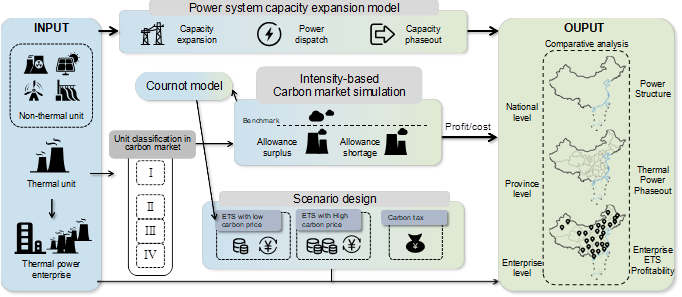
Figure 1 Modeling framework for the impact of the national carbon market on power system decarbonization pathways
The power industry is a core arena for achieving China's "dual carbon" goals and global climate governance objectives. As the world's largest coal-fired power generation system, China's power sector has long faced two parallel challenges: on one hand, it needs to continuously reduce high-carbon power sources and increase the share of clean energy such as wind and solar; on the other hand, it must balance system reliability, power supply security, and the exit risks associated with existing coal power assets. Particularly, a large number of China's coal power units were commissioned relatively late and have low average ages, meaning that coal power exit is not simply a matter of "high carbon equals elimination," but involves multiple trade-offs including carbon lock-in, asset stranding, and regional energy security. Against this backdrop, as one of China's most important market-based mitigation tools, whether the CN ETS can truly promote the orderly phase-out of coal power and how it affects the transition pathways of different regions and enterprise types have become pressing practical questions requiring answers.
Addressing these issues, the research team started from the micro-level of units and enterprises, constructing a database of thermal power units regulated under China's national carbon market and embedding it into the SWITCH-China capacity expansion model with high spatial and temporal resolution. Unlike traditional approaches that treat carbon prices as exogenous parameters directly superimposed onto generation costs, this study further incorporated an intensity-based carbon market mechanism, establishing a dynamic carbon emission intensity model. Through an iterative process of "quota supply-demand, carbon price formation, unit dispatch, and enterprise profit/loss feedback," it achieved a coupled simulation of power system planning and carbon trading mechanisms. Based on this framework, the study designed a baseline scenario, a low-carbon-price ETS scenario, and a high-carbon-price ETS scenario, systematically comparing the evolutionary pathways of national and provincial power systems under different policy intensities.

Figure 2 (a) National installed capacity structure, (b) Capacity of units regulated by ETS, and (c) Profits of different unit types in ETS from 2025-2050 under different scenarios
The study found that the introduction of the CN ETS will generally reshape the decarbonization pathway of China's power system and significantly affect the retirement rhythm of coal power units. Results indicate that by 2050, the share of renewable energy installed capacity is expected to rise to approximately 66%, with wind and solar becoming the mainstay of future power system expansion. Simultaneously, the effect of the ETS on coal power retirement is not simply linear: small-capacity units face faster retirement across all scenarios, and the ETS further accelerates their phase-out; 300MW and 600MW units constitute the main body of coal power retirements; while large-capacity, high-efficiency units such as 1000MW units are relatively insensitive to carbon price changes and even show a stronger "retention" tendency during certain periods. This implies that higher carbon prices will not necessarily accelerate the retirement of all coal power units indiscriminately, but may instead enhance the relative competitiveness of large, efficient units within the system.
Further analysis reveals significant inter-provincial heterogeneity in the policy effects of the CN ETS. Based on these findings, the research team categorized the retirement pathways of regulated units across provinces into three types: one exhibits relatively smooth, near-linear exit characteristics; another maintains stability for an extended period before concentrated retirements occur at specific stages; and a third presents special retirement patterns influenced by local energy structures, the share of gas-fired units, or the degree of coal power dependence. This indicates that although the national carbon market provides a unified price signal at the national level, its transmission effects are distinctly differentiated due to varying provincial resource endowments, coal power dependence, and unit portfolio structures. Therefore, a unified policy framework still requires more targeted local supporting measures.
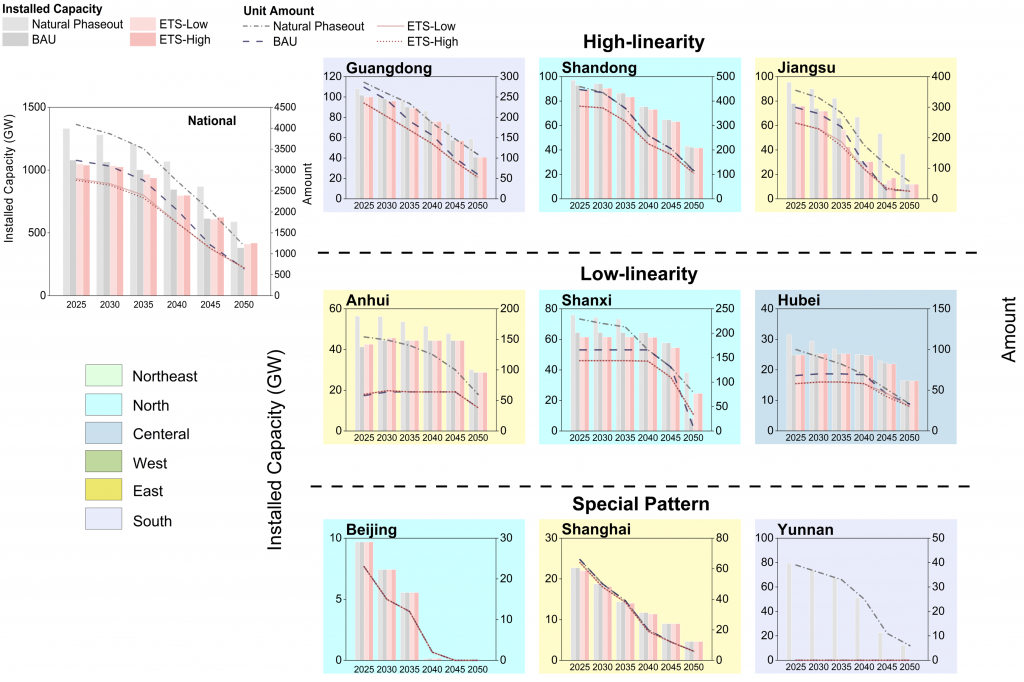
Figure 3 Inter-provincial heterogeneity characteristics of regulated coal power unit retirement under the national carbon market
At the enterprise level, the study reveals a noteworthy phenomenon: carbon revenues and costs under the CN ETS are highly concentrated, with a relatively low proportion of enterprises truly and persistently active in carbon trading. The research shows that as older units retire and some low-efficiency enterprises gradually withdraw from power dispatch, by 2050, approximately 90.2% of regulated enterprises will neither obtain significant carbon market revenues nor bear substantial carbon costs. This means that under the current carbon market coverage mechanism, although a large number of marginal enterprises are included in the regulatory scope, their actual trading activity and market influence are limited. Simultaneously, higher carbon prices may raise the capacity threshold for enterprises to substantively participate in carbon trading, further concentrating carbon market revenues among a smaller number of larger, more efficient enterprises.
This study not only reveals the dynamic impact of the CN ETS on coal power exit and power structure reshaping at the unit level but also depicts the concentration characteristics of carbon revenue distribution patterns at the enterprise level, providing new micro-level evidence for understanding how the national carbon market influences the long-term transition of China's power system. The research further suggests that future policy design should place greater emphasis on layered and differentiated approaches: for small-capacity, inefficient units, phase-out should be accelerated through clearer retirement constraints; for medium-capacity units, quota allocation and carbon market incentive mechanisms should be optimized to guide orderly exit; for large, efficient units, stricter technical standards and long-term constraints are needed to prevent the formation of new carbon lock-in during the transition period. Meanwhile, at the inter-provincial level, a more refined and differentiated transition policy framework should be constructed based on variations in coal power dependence, system resilience, and energy structure across different regions.
The first author of the paper is Lu Zhenwei, a doctoral student at the School of Environmental Science and Engineering, Southern University of Science and Technology (SUSTech). The corresponding author is Assistant Professor Ye Bin. SUSTech is the sole corresponding affiliation. Co-authors include Associate Professor He Gang from the City University of New York and Professor Shao Shuai from Tongji University, among others. The research was supported by the National Natural Science Foundation of China (Grant Nos. 72173058, 72573075, 72573116, 72243004 and 72394391) and the High-Level University Special Fund (Grant Nos. G030290001 & G03050K001).