 English
  简体中文
简体中文 In March 2024, the research group of Assistant Professor Bin Ye at the School of Environmental Science and Engineering, Southern University of Science and Technology, made significant progress in the field of methane abatement technology innovation and international diffusion. The team participated in the publication of the paper “Global trend of methane abatement inventions and widening mismatch with methane emissions” in the top climate-change journal Nature Climate Change. This marks the third research achievement co-authored by Bin Ye’s group in Nature sub-journals since 2023.
In January 2023, the team contributed to the paper “A global-scale framework for hydropower development incorporating strict environmental constraints” published in Nature Water. This study assessed the economically exploitable hydropower potential worldwide and found that global hydropower capacity could still be doubled, enabling hydropower to play a greater role in achieving carbon neutrality. In March of the same year, the team also participated in the paper “Energy production and water savings from floating solar photovoltaics on global reservoirs” published in Nature Sustainability. This study evaluated the global potential of floating photovoltaic (FPV) systems on reservoirs and found that reservoir-based FPV could generate more than twice the current global hydropower output, thereby improving energy and water security and advancing sustainable development goals.
“Global trend of methane abatement inventions and widening mismatch with methane emissions”:
Since the First Industrial Revolution, atmospheric methane concentrations have doubled, reaching a record high in 2022, contributing to about one-third of global warming. Given methane’s strong greenhouse effect and relatively short atmospheric lifetime, reducing methane emissions is considered one of the most effective strategies to curb short-term warming and to achieve the 1.5 °C target. However, a systematic classification framework for methane abatement technologies and patents has not yet been established.
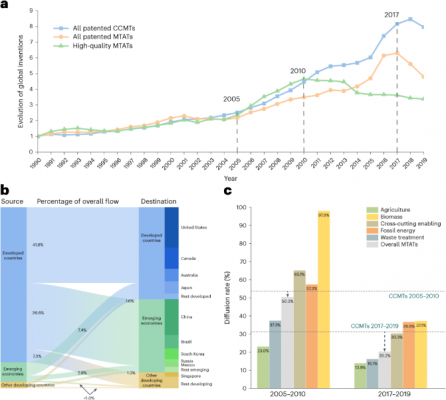
To address this gap, the research team developed a novel patent search and classification methodology targeting methane abatement and methane removal. They systematically analyzed over 175,000 methane-related invention patents between 1990 and 2019 across five major sectors: agriculture and livestock, fossil fuels, waste, biomass, and cross-sector enabling technologies. Results show that although high-quality inventions grew rapidly between 1990 and 2010, they have declined at an average annual rate of about 3.5% since 2010. Compared with general greenhouse gas abatement technologies, the international diffusion rate of methane abatement technologies is about 11.1% lower, with flows largely confined to developed countries or from them to China and Brazil, while other developing countries and least developed countries were rarely involved.
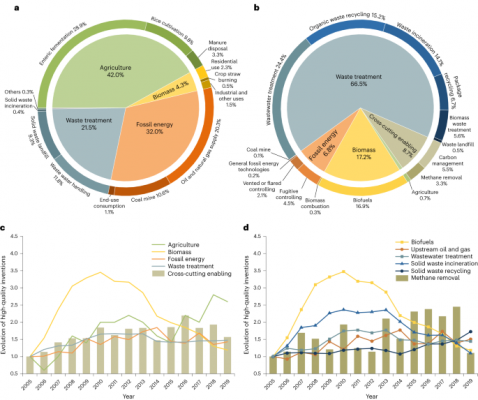
The study also found a significant mismatch between regions with strong innovation capabilities in methane abatement technologies and regions with growing methane emissions. Developed countries account for more than half of global high-quality methane abatement patents, even though their methane emissions have slowed or declined. By contrast, future methane emission growth is expected mainly from developing countries, particularly in agriculture, livestock, and waste management, but these regions show very weak innovation capacity. This imbalance highlights the urgent need to strengthen technology transfer and financial support to developing and least developed countries.
This study was jointly conducted by Bin Ye’s group and the Low Carbon and Innovation Team from School of Economy and Management, Harbin Institute of Technology (Shenzhen).
Paper link (copy link to browser accessible):https://www.nature.com/articles/s41558-024-01947-x#Tab1
“A global-scale framework for hydropower development incorporating strict environmental constraints”
Hydropower is one of the most important renewable energy sources. Its reliability, stability, and environmental benefits make it an ideal substitute for coal-fired power. Currently, hydropower accounts for about 17% of global electricity generation and 69% of renewable electricity. However, hydropower development often causes environmental and social impacts, including damage to river ecosystems, blockage of fish migration, reservoir-related greenhouse gas emissions, resettlement issues, and geopolitical challenges, which have raised debates over the sustainability of future hydropower expansion.

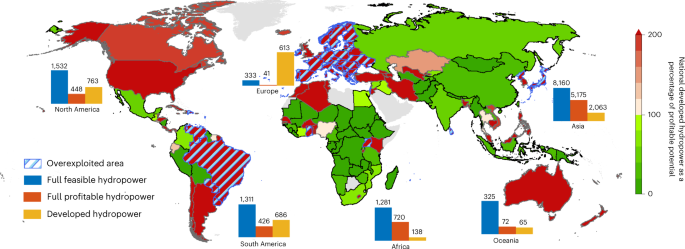
The research team applied global high-resolution runoff datasets, using the advanced VIC hydrological model and RAPID routing model to simulate 2.89 million rivers worldwide, and virtually sampled 4.14 million potential hydropower sites along these rivers. They then constructed a quantitative assessment framework under strict environmental constraints to calculate the levelized cost of electricity (LCOE) for both reservoir-type and diversion-type hydropower plants at different configurations. Results show that there remain over 120,000 undeveloped potential hydropower sites globally, among which 4,644 sites have strong economic development value with an LCOE below $0.10/kWh. The global economic potential of undeveloped hydropower is estimated at 5.27 trillion kWh/year, with Asia standing out (3.90 trillion kWh/year), more than triple previous estimates, particularly in the Himalayas. Africa’s potential is estimated at 0.60 trillion kWh/year. Together, Asia and Africa account for 85% of the global undeveloped hydropower potential.
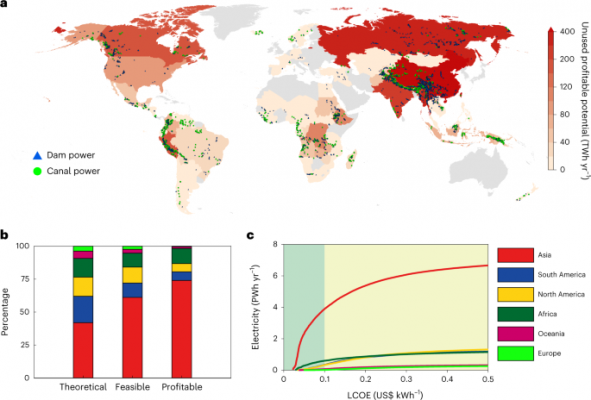
China holds the world’s largest undeveloped hydropower potential, mainly concentrated in Tibet, Sichuan, Yunnan, and Guizhou, capable of meeting 30% of the nation’s power demand. In the Himalayas, geopolitical complexities require enhanced regional cooperation, while in Africa, large-scale hydropower development is crucial for food, energy, and water security in the context of rapid population growth.
This research was jointly conducted by Bin Ye’s group, Zhenzhong Zeng’s group from the School of Environmental Science and Engineering at SUSTech, and international collaborators.
Paper link (copy link to browser accessible):https://www.nature.com/articles/s44221-022-00004-1
“Energy production and water savings from floating solar photovoltaics on global reservoirs”
Installing photovoltaic systems on reservoirs presents multiple advantages. This approach conserves valuable land resources, reduces transmission costs since reservoirs are often located near existing grids, and benefits from the cooling effect of water evaporation, which increases PV efficiency. At the same time, shading reduces evaporation losses, helping conserve water resources.
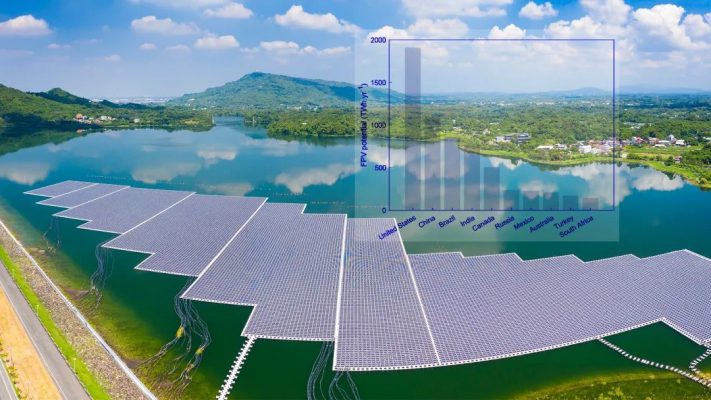
Using global reservoir datasets and Sandia National Laboratories’ PV performance model (PV_LIB), the research team estimated the immense generation potential of FPV systems worldwide. Under a conservative scenario of covering 30% of reservoir surface area (with each covering less than 30 km²), FPV could generate around 2 trillion kWh annually in the U.S. and 1 trillion kWh annually in China.
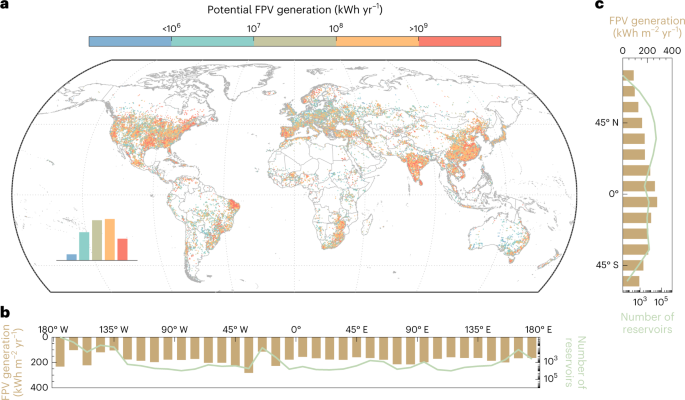
A key advantage of reservoir FPV is its proximity to population centers with high electricity demand, making FPV suitable for cities or communities seeking to generate electricity independently, compete with large utilities, and stimulate local economies. Under favorable conditions, many cities could even achieve electricity self-sufficiency using local reservoir FPV plants. Furthermore, FPV-based microgrids can offer flexible and cost-effective power solutions for remote areas.
If water surfaces were fully covered with FPV, evaporation would be nearly eliminated in the covered areas. The study estimates that covering 30% of reservoir surfaces with FPV could reduce evaporation by an average of 46%, saving about 106 km³ of water annually worldwide—equivalent to the annual water consumption of nearly 300 million people.
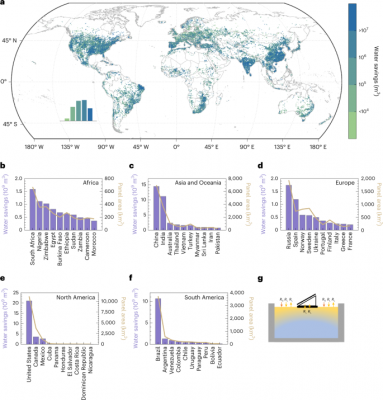
This research was jointly conducted by Bin Ye’s group, Zhenzhong Zeng’s group from the School of Environmental Science and Engineering at SUSTech, and international collaborators.
Paper link (copy link to browser accessible):https://www.nature.com/articles/s41893-023-01089-6
All three studies were supported by the National Natural Science Foundation of China (Grant No. 72173058), led by Bin Ye.