 English
  简体中文
简体中文 Recently, Assistant Professor Ye Bin from the School of Environmental Science and Engineering at Southern University of Science and Technology published a paper titled “Research on quantitative assessment of climate change risk at an urban scale: Review of recent progress and outlook of future direction” in the top journal of environmental sustainability, Renewable and Sustainable Energy Reviews (IF 12.110). The paper systematically summarizes the latest research achievements in the quantitative assessment of climate change risk at the urban scale.
Cities account for two-thirds of global energy consumption and 70% of global anthropogenic greenhouse gas emissions. Due to the high concentration of population, wealth, and infrastructure, cities are not only major contributors to global climate change but also the primary areas affected by it. Quantifying and assessing the risks potentially caused by climate change is of great significance for proactive climate adaptation and risk prevention in cities. However, previous studies have mostly focused on global, national, or large regional scales, with very few studies on urban-scale climate risk. Quantitative assessment of urban climate change risk remains highly challenging. Figure 1 illustrates the impact of climate change on cities.
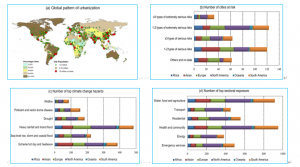
Figure 1: Climate Change Risks to Cities (a) Global urbanization patterns derived from the World Cities Report 2016, (b) Number of cities with different types and degrees of climate change risks, (c) Number of top climate hazards affecting cities, (d) Number of top urban sectors affected by climate hazards
Research Content
This study is divided into two main parts. The first part, after summarizing and analyzing the latest research progress, discusses seamless coupling of climate simulations and compound climate reproduction across different scales, including long-term non-market impacts, and the main challenges to be overcome in representing risk transfer within or outside cities. It is discussed from the following four aspects: downscaling of large-scale climate change, urban development and microclimate simulation, vulnerability assessment of urban climate change, and comprehensive assessment of urban climate change risk. The second part, based on the first part, mainly explores future research prospects, focusing on improving research methods, enriching knowledge of climate change impacts on cities, enhancing data abundance and availability, and exploring best practices for urban climate risk services. The main framework of this paper is shown in Figure 2.
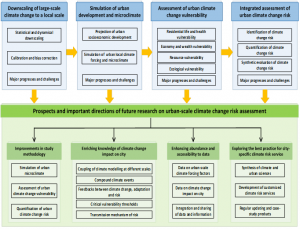
Figure 2:Overall framework of the research in the paper
Cities are highly exposed to the impacts of climate change and interact with regional climates to shape local microclimates. Although well-processed regional climate model results can reflect the overall urban climate, they still cannot provide detailed information on urban microclimates. After downscaling climate change simulations, it is necessary to predict local climate change factors driven by urban expansion and socio-economic development, and then couple these changes with regional climates to simulate future urban microclimates, as shown in Figure 3.
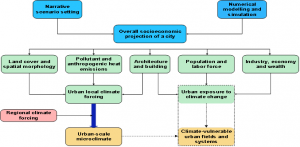
Figure 3: General framework for predicting future socio-economic development and microclimate of cities
The specific impact of climate change on each city depends on the local climate changes experienced by the city and its response methods. Therefore, after predicting urban microclimates, it is necessary to review the vulnerability of various urban sectors and systems to climate change impacts. The four main concerns for urban managers and residents are residential life and health, economy and wealth, resource availability, and biodiversity.
There are many uncertainties in almost every step of urban microclimate simulation, socio-economic forecasting, and vulnerability assessment. Many researchers have tried to address the issue of uncertain impacts and urban damages under multiple uncertainties, but there are significant inconsistencies in their analytical methods. To fully understand how climate change will affect future uncertain urban systems, the comprehensive assessment of urban climate change risk includes three main modules: risk identification, risk quantification, and risk synthesis. The assessment is a continuous and iterative process with substantial information exchange between any two modules, as shown in Figure 4.
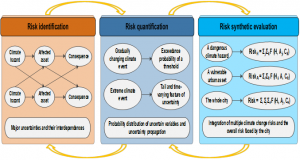
Figure 4:Comprehensive assessment framework for urban climate change risk
The first author of this paper is Visiting Assistant Professor Ye Bin from the School of Environmental Science and Engineering at Southern University of Science and Technology. Associate Professor Jiang Jingjing from Harbin Institute of Technology (Shenzhen), Professor Liu Junguo and Professor Zheng Yi from the School of Environmental Science and Engineering at Southern University of Science and Technology, and Researcher Zhou Nan from Lawrence Berkeley National Laboratory participated in the discussion and revision of the paper. Southern University of Science and Technology is the first author’s institution.
This project was supported by the Ministry of Science and Technology’s Key Research and Development Program (2018YFE0206200), the National Natural Science Foundation of China (71803074), and the Shenzhen Natural Science Foundation (JCYJ20190806144415100, JCYJ20190809162809440).
Ye Bin is the Party Branch Secretary of the Faculty and Staff at the School of Environment and an Assistant Professor at Southern University of Science and Technology. Since joining the university two and a half years ago, he has published 12 high-impact papers in top journals of environment and sustainability, including Renewable and Sustainable Energy Reviews (IF 12.110), Applied Energy (IF 8.848), and Resources, Conservation & Recycling (IF 8.086). He has published more than 60 research papers in total and has presided over national, provincial, and municipal natural science funds as well as the China Postdoctoral Science Fund.
Article link: https://doi.org/10.1016/j.rser.2020.110415