 English
  简体中文
简体中文 Recently, the research group of Assistant Professor Bin Ye from the School of Environmental Science and Engineering at Southern University of Science and Technology published their latest research results entitled “Environmental and economic evaluation of urban building-integrated photovoltaic and electric vehicle system” in Journal of Building Engineering, a Q1 journal in engineering.
The rapid development of photovoltaic power generation technology has become an important means for cities to reduce carbon emissions. Compared with large-scale PV power plants, distributed building-integrated photovoltaic (BIPV) systems installed on unused building surfaces neither occupy limited land resources nor disrupt ecological balance. With the advancement of flexible PV modules and the gradual improvement of PV efficiency, the development of PV resources on urban building facades has become increasingly economically feasible. Moreover, with the continuous increase in renewable energy capacity, more renewable energy is being integrated into urban power grids. For renewable energy systems with a relatively high share, electric vehicles (EVs) serve as important sources of energy storage, and their large-scale integration affects the load characteristics of building electricity consumption.
At present, there is still a lack of research on the environmental and economic analysis of BIPV systems including facade photovoltaics (FaPV). In this regard, this study proposes a coupled development model of “building photovoltaics + electric vehicles” in newly built cities, which can achieve effective renewable energy utilization and carbon reduction. The study establishes a comprehensive assessment framework (Figure 1) to optimize the overall economic benefits of urban BIPV-EV integrated systems, and evaluates the energy-environment-economy (3E) potential of BIPV-EV integrated systems under multiple scenarios, filling the research gap on the economic potential of facade photovoltaics.
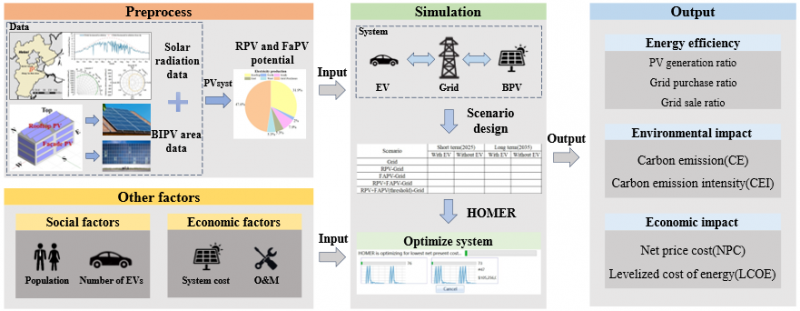
Figure 1. Research framework of BIPV-EV system
The results show that BIPV-EV systems can effectively reduce CO2 emissions and lower electricity costs (Figure 2). Specifically, compared with BIPV systems that only use rooftop photovoltaics (RPV), the installation of FaPV can increase power generation by up to 67.60%. In terms of urban decarbonization, the adoption of BIPV systems can reduce CO2 emissions by 41.91% in the short term and 34.99% in the long term. The evaluation of the levelized cost of energy (LCOE) for different schemes indicates that the configurations of RPV+FaPV (SE)-EV and RPV+FaPV (SW)-EV systems are the most cost-effective options in both the short and long term, in which BIPV accounts for 48.10% and 31.90% of the total power generation, respectively.
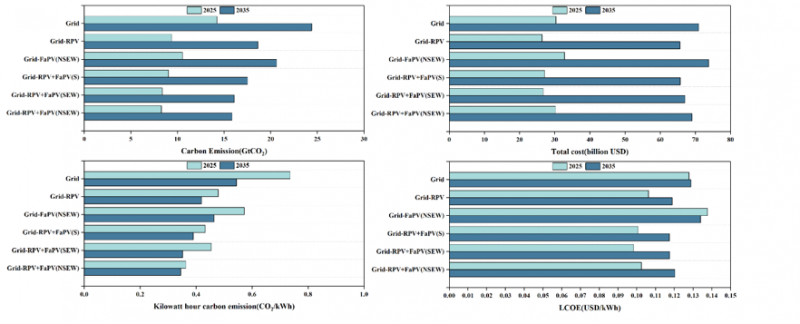
Figure 2. Comparison of environmental and economic parameters of BIPV-EV system under multiple scenarios
In addition, regarding EV coupling, under the scenarios with the greatest short-term and long-term potential of PV systems, the adoption of EVs can reduce the electricity sales ratio by 15.38% and 30.20%, respectively (Figure 3). Therefore, although the incorporation of EVs into the power system complicates the energy structure, operation mode, and related scheduling methods of the existing power system, it solves the problem of electricity consumption when PV power generation is excessive.
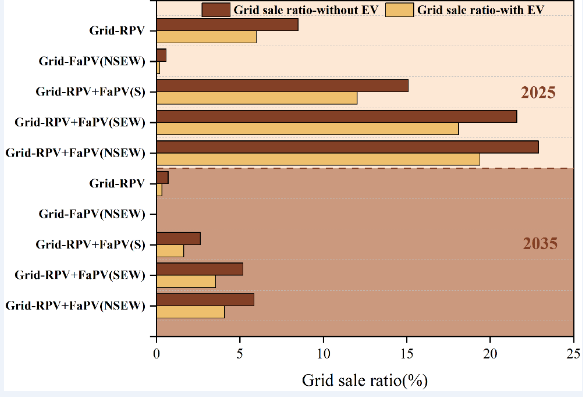
Figure 3. Comparison of grid sales ratio with and without electric vehicle integration under multiple scenarios
Furthermore, in order to account for uncertainties in the data, the research team conducted sensitivity analysis (Figure 4). The results show that the development choices of BIPV differ between the short term and the long term: in the short term, the use of RPV+FaPV (SEW) systems is more advantageous, while in the long term, the use of RPV+FaPV (SW) systems is more favorable. In such cases, the LCOE difference between the optimal solution system and the original economically optimal solution system is less than 1%, indicating that the impact on future urban planning is minimal and can be neglected.
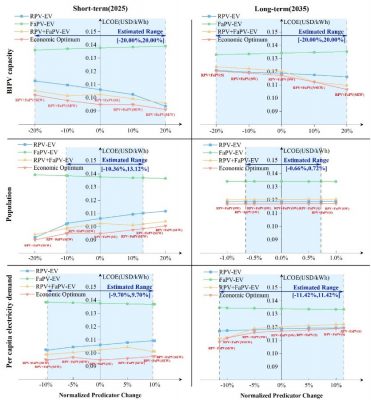
Figure 4:Sensitivity analysis of electricity consumption and photovoltaic development factors
Southern University of Science and Technology is the first corresponding institution of this paper. Master’s student Zhe Yu from Bin Ye’s research group at the School of Environmental Science and Engineering is the first author, and Assistant Professor Bin Ye is the corresponding author. Co-authors of the paper also include Associate Professor Jingjing Jiang from Harbin Institute of Technology (Shenzhen). The research was supported by the National Natural Science Foundation of China, the Natural Science Foundation of Guangdong Province, among others.
Article link: https://www.sciencedirect.com/science/article/pii/S235271022401773X