English
  简体中文
简体中文 In September 2024, the research group of Assistant Professor Bin Ye from the School of Environmental Science and Engineering at Southern University of Science and Technology published a research paper entitled “Carbon Abatement and Leakage in China’s Regional Carbon Emission Trading” in Environmental Science & Technology (EST), a top-tier journal in the field of energy and environment. This research mainly focuses on whether the regionally operated ETS would lead to carbon leakage in the absence of a globally unified carbon pricing system, and based on the results, it proposes policy recommendations on formulating strict penalty rules for violations and introducing diversified carbon financial products and market participants.
As the threat of global climate change to human society continues to intensify, China, as the world’s largest carbon emitter, has attracted worldwide attention for its policies and actions in addressing climate change. Chinese policymakers have been seeking to achieve carbon abatement in the most cost-effective way and have proposed to gradually establish a nationwide carbon emission trading scheme (ETS). From 2013 to 2014, China launched pilot regional ETS programs in seven regions, including Beijing, Shanghai, Tianjin, Chongqing, Shenzhen, Guangdong, and Hubei. The latest research results show that while China’s regional ETS reduces carbon emissions in pilot cities, it may cause carbon leakage through production outsourcing and the spatial dependence of economic activities, thereby increasing carbon emissions in surrounding cities. This finding provides new perspectives and insights for the formulation and implementation of global carbon trading policies.
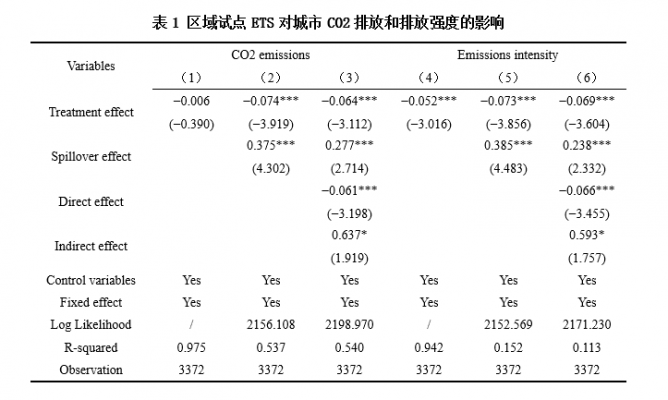
Based on this, the study exploits the quasi-natural experiment created by the pilot policies of China’s regional ETS, and uses city-level CO2 emissions data calculated from subdivided categories of energy consumption to examine the impacts of regional ETS on CO2 emissions and emission intensity (CO2 emissions per unit of GDP) inside and outside the policy-implementing cities, using the spatial difference-in-differences (SDID) method. The results, as shown in Table 1, indicate that in columns (1) and (4), the estimates of the traditional DID model suggest that regional ETS has a suppressing effect on CO2 emissions in pilot cities but the result is not statistically significant, while it significantly reduces the CO2 emission intensity of pilot cities. However, this result may be biased, because the spatial interdependence and interaction between cities violate the SUTVA assumption of the DID model, i.e., that policy intervention does not generate spillover effects. Therefore, the SDID model is employed to more accurately evaluate the impact of ETS. The results in columns (2) and (5) show that China’s regional ETS has significant negative treatment effects and significant positive spillover effects on both CO2 emissions and emission intensity, i.e., while reducing CO2 emissions and emission intensity in pilot cities, it increases CO2 emissions and emission intensity in surrounding cities. To capture policy effects more accurately, a decomposition analysis is further conducted. The results in columns (3) and (6) show that China’s regional ETS reduces local CO2 emissions by 6.1% and lowers local CO2 emission intensity by 6.6%. At the same time, the ETS of pilot cities collectively increase CO2 emissions in surrounding cities by 63.7% and emission intensity by 59.3%. That is, each pilot city’s carbon trading leads to an average increase of 1.7% in CO2 emissions and 1.6% in emission intensity in surrounding cities (by dividing the joint indirect effects by the number of pilot cities, 37). In sum, China’s regional ETS helps to reduce CO2 emissions and emission intensity in regulated cities but causes carbon leakage to surrounding cities.
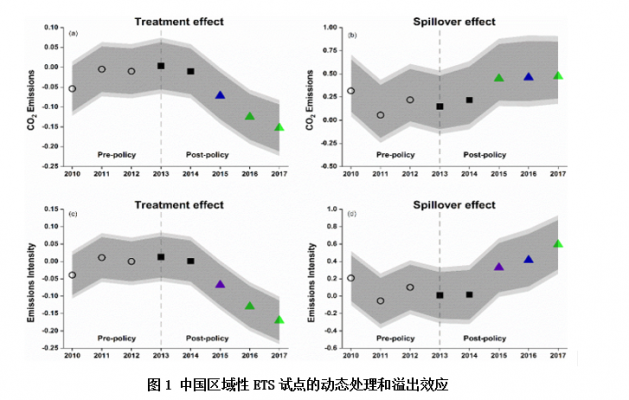
On this basis, the study further analyzes how the impacts of regional ETS change over time and finds that the carbon abatement effect in pilot cities becomes stronger, while the carbon leakage to surrounding cities becomes more severe. The specific results are shown in Figure 1.
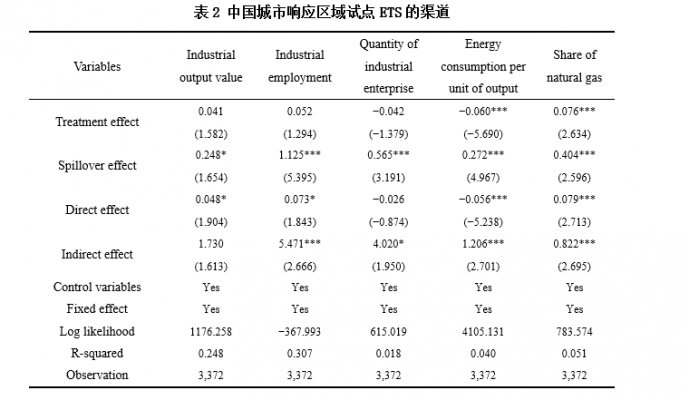
As for the reasons, the study empirically finds that China’s regional ETS achieves carbon abatement through two channels. On the one hand, implementing ETS in pilot cities increases the industrial output value and the number of industrial enterprises in neighboring cities, indicating that industrial production has been outsourced from ETS-regulated cities to unregulated cities, which helps reduce local CO2 emissions through emission transfer. It is easier to transfer production and industries domestically than internationally, making it a critical issue to consider how to address carbon transfer caused by industrial relocation under domestic regional carbon regulation. On the other hand, the study shows that China’s regional ETS improves the energy efficiency of regulated cities and increases the share of low-carbon fuels in energy consumption, thereby contributing to regional carbon abatement through local efforts. Detailed empirical supporting results are shown in Table 2. Due to their cost-effectiveness, energy efficiency technologies and measures have been widely adopted as feasible means of mitigating carbon emissions, which has been confirmed in the EU ETS and Tokyo ETS.
Then, is carbon leakage caused by outsourced production? This remains an unresolved issue. Although outsourced production is accompanied by the transfer of associated emissions, it may also bring technological spillovers, which could help improve energy and carbon efficiency in host countries or regions with relatively loose climate regulations. When technological effects outweigh scale effects, negative carbon spillovers may occur, which could help reduce carbon emissions in cities surrounding ETS-implementing regions. This situation has been observed in the Tokyo ETS, while literature on China’s regional ETS remains divided. This study finds that China’s regional ETS significantly increases the number of industrial enterprises and jobs in unregulated cities. Outsourcing carbon-intensive industries not only increases CO2 emissions in unregulated cities through scale effects but also makes their industrial structure more imbalanced, thereby reducing their carbon efficiency. This indicates that although technological spillovers help improve carbon efficiency in certain industries, the rising share of carbon-intensive industries and the more severe industrial structure may reduce the overall carbon efficiency of unregulated cities. Therefore, more attention should be paid to the potential impact of regional ETS on industrial structure changes and to improving the efficiency gains from industrial clusters. This study finds that although China’s regional ETS reduces the energy efficiency of surrounding cities, it stimulates their shift from coal to natural gas. The positive spillover in energy structure decarbonization helps reduce CO2 emissions in unregulated cities. Overall, the positive spillover effects from production outsourcing and energy efficiency decline cannot be offset by the negative spillover effects from fuel switching. Therefore, China’s regional ETS leads to positive carbon leakage, raising CO2 emissions in unregulated cities. Drawing on international best practices and recent literature, policymakers should deploy diversified instruments to mitigate carbon leakage, such as output-based or intensity-based rebates, consumption taxes on carbon-intensive goods, entry standards for energy-intensive enterprises, as well as interregional technology sharing and industrial alliances.
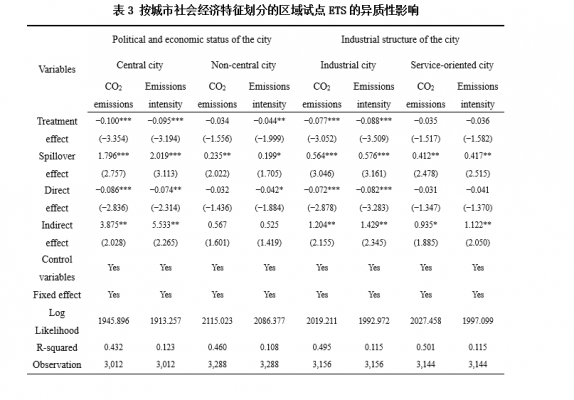
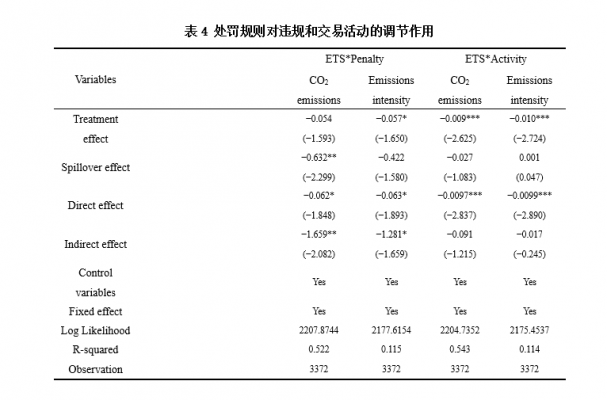
Finally, the study reveals that the performance of ETS varies greatly depending on socioeconomic context. Detailed empirical supporting results are shown in Table 3. Regional ETS implemented in China’s central cities (referring to municipalities, provincial capitals, and first-tier megacities) can significantly reduce local CO2 emissions and emission intensity, while ETS in non-central cities has no significant impact on local CO2 emissions. Comparatively, the carbon abatement effect of ETS is better in central cities because their political and economic influence promotes strong policy enforcement and rapid behavioral responses. In addition, China’s regional ETS produces greater carbon abatement effects in industrial cities than in service-oriented cities, mainly because carbon-intensive industrial enterprises are the primary focus of ETS regulation. Moreover, the study empirically finds that strict penalty rules and active quota trading help deepen carbon abatement. Detailed empirical supporting results are shown in Table 4. Strict penalty rules for violations not only help deepen local carbon abatement but also help reduce carbon leakage. Therefore, China’s national ETS and other upcoming ETSs should be designed with strict penalty rules for violations. In addition, the allowance turnover rate of China’s national ETS in the first compliance phase was only 3.98%, far lower than international carbon markets. The inactivity of China’s carbon trading can be attributed to the contradiction between the inherent demand of regulated enterprises for carbon financial services and the cautious stance of the Chinese government on whether the carbon market should be given more financial attributes. Drawing on the experience of the EU ETS and California ETS, China’s ETS should proceed in an orderly manner, activate trading, and introduce diversified carbon financial products and market participants.