 English
  简体中文
简体中文
Recently, Assistant Professor Bin Ye from the School of Environmental Science and Engineering at Southern University of Science and Technology (SUSTech) published his latest research in the well-known journal Environmental Impact Assessment Review (EIA), entitled “Design and Pricing of an Option Product for China’s Green Electricity-Carbon Medium and Long-Term Markets.” This study proposes the design and pricing scheme of a green electricity–carbon option product tailored to China’s actual conditions, providing significant support for the coordinated development of China’s carbon and electricity markets.
EIA is a top-tier journal ranked in both JCR and the Chinese Academy of Sciences Q1 category, with a 2023 impact factor of 9.8, making it one of the leading journals in the field of social sciences.
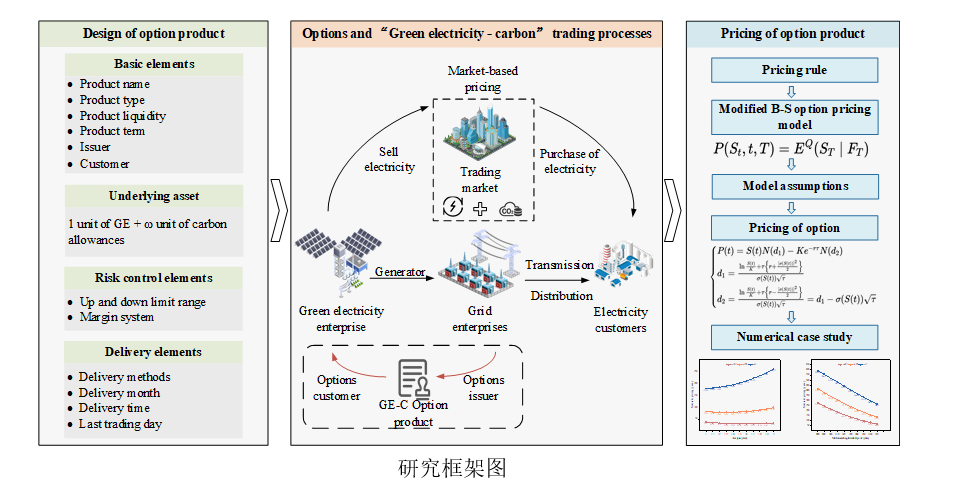
At present, China’s electricity market and carbon trading market operate independently, overseen by different administrative authorities and supported by different trading platforms. This separation results in a lack of overall coordination and effective synergy in top-level market design. The overlapping responsibilities of different departments lead to issues such as duplicated market functions, underutilized roles, and high management costs. While the two markets are managed independently, they are inherently connected: power generation enterprises act as common participants in both, linked indirectly through electricity–carbon price transmission mechanisms. With the establishment of a unified national market and the growing demand for low-carbon development among enterprises, the interconnection between these markets will only become stronger. In the future, leveraging green electricity trading to further integrate the electricity and carbon markets, and to establish a unified market development mechanism, will be essential for optimizing resource allocation and achieving coordinated energy and climate governance in China.
To promote the coordinated development of the green electricity and carbon markets, in January 2022, the National Development and Reform Commission and six other ministries jointly issued the Implementation Plan for Promoting Green Consumption. This plan emphasized the need to “strengthen the linkage with the carbon emission trading scheme and explore the feasibility of deducting relevant green electricity carbon emissions in carbon accounting.” This demonstrates that, under the dual drivers of policy and market mechanisms, the linkage between the two markets will be further strengthened, helping to avoid the double payment of environmental costs by electricity enterprises. However, significant challenges remain. First, the current green electricity pricing mechanism only reflects the energy value of electricity but does not capture its environmental premium. Second, the price of green electricity is highly volatile, exposing investors to excessive risks. Although the two markets operate independently, their emission reduction goals remain aligned.
To clarify the relationship between green electricity and carbon allowances, and to achieve deep coordination between the two markets, it is necessary to build a trading system centered on electricity transactions. Such a system would allow electricity prices to reflect both supply–demand dynamics and carbon reduction costs, forming a pricing system that integrates electricity and carbon prices. This paper first draws on financial derivatives commonly used in carbon markets, designing a customized option product for China’s medium and long-term green electricity–carbon market, with the weighted spot price of Green Electricity (GE) and carbon allowances as the underlying asset. Then, the paper applies an improved Black-Scholes-Merton real option pricing model to evaluate the product. Finally, numerical case studies analyze the effects of six key factors on the option premium and identify the reasonable range for green electricity–carbon market coordination ratios.
The study finds that developing appropriate financial derivatives and trading mechanisms can enhance synergy between the green electricity and carbon markets. By designing green electricity–carbon products under the principle of “green electricity price as the main factor, carbon allowance price as the supplementary factor,” the environmental value of green electricity can be effectively reflected, thereby improving its competitiveness and investment attractiveness. Among the factors affecting option premiums, the strike price has the greatest influence: the higher the strike price, the lower the option premium. Notably, when the strike price approaches the spot price, the premium can differ by a factor of three. In contrast, the risk-free interest rate has a relatively minor impact. The study further identifies that when the ratio of green electricity price to carbon allowance price falls within 1:0.1 to 1:0.5, the coordination effect of the carbon market is reasonable, option price volatility is low, and market coordination risks are reduced.
This research demonstrates the environmental value of green electricity in the carbon market in the form of emission reduction costs. It helps stimulate investor interest in green electricity, promotes the development of the green power industry, and offers a solution for transitioning from relatively independent electricity and carbon markets to coordinated and unified market design. It provides theoretical and technical support for the construction and operation of China’s national electricity–carbon market, decision-making guidance for grid companies and power generation enterprises participating in electricity–carbon trading, and valuable reference for building and advancing China’s unified national market.
Assistant Professor Bin Ye from the School of Environmental Science and Engineering at SUSTech is the first and corresponding author of this paper, with SUSTech as the sole corresponding institution. Co-authors include Hongjiang Pu (Research Assistant in Ye’s group), Associate Professor Yazhi Song (Jiangsu Normal University), and Associate Professor Jingjing Jiang (Harbin Institute of Technology, Shenzhen). This work was supported by the National Natural Science Foundation of China (projects 72173058 and 72394391, hosted and participated by Bin Ye), as well as financial support from State Grid Hubei Electric Power Co., Ltd.